
Content Writing and Content Marketing
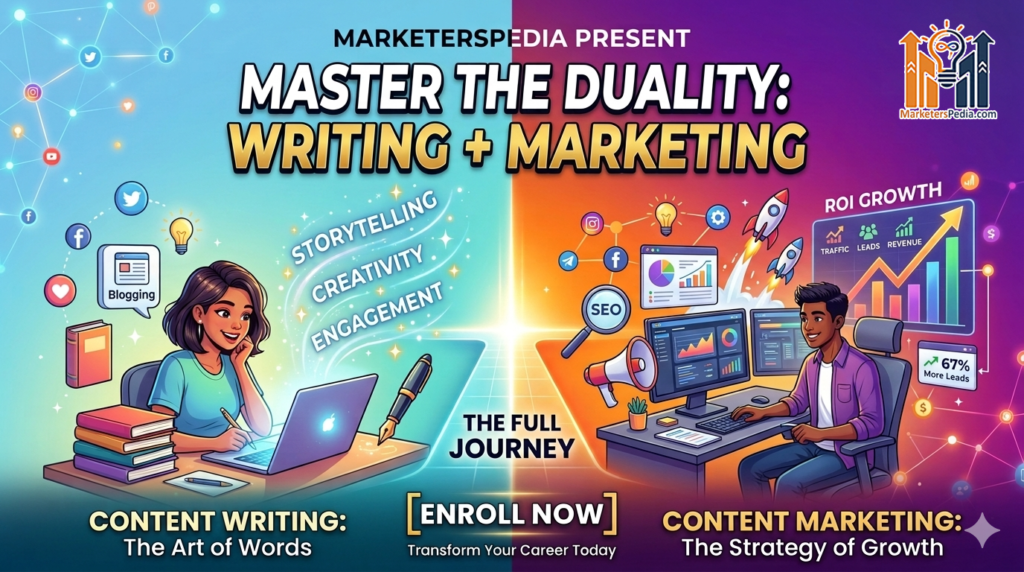
In the fast-evolving digital landscape of 2026, content is no longer just a supporting player; it is the cornerstone of every successful brand strategy. For businesses, it is a bridge to trust and authority; for students, it is one of the most versatile and high-growth career paths available.
To bridge the gap between creative writing and strategic marketing, MarketersPedia offers a comprehensive Content Writing and Marketing Course designed to turn aspiring writers into industry-ready digital strategists.
The Power of Content Marketing for Businesses
Content marketing has fundamentally shifted from traditional “push” advertising to an “inbound” pull strategy. Instead of interrupting users with sales pitches, businesses now attract them by providing genuine value through information and storytelling.
- Massive Lead Generation: Companies that prioritize strategic content marketing generate approximately 67% more leads than those that do not.
- Superior ROI: Content marketing is remarkably cost-effective, costing roughly 62% less than traditional outbound marketing while generating triple the leads.
- Trust and Authority: Consistently delivering high-quality insights establishes a brand as a “thought leader”. In 2026, roughly 88% of B2B decision-makers believe that thought leadership content significantly improves their perception of an organization.
- SEO Dominance: Search engines reward websites that publish fresh, relevant content. Over 75% of B2B content consumption begins with an organic search, making findability essential for survival.
- Customer Retention: Beyond acquiring new leads, content like newsletters and how-to guides keeps existing customers engaged, reducing churn and increasing lifetime value.
Modern Challenges for Businesses
While the benefits are clear, the 2026 market presents unique hurdles that require specialized skills to overcome:
- Content Saturation: With millions of terabytes of data created daily, standing out in an “overcrowded digital space” is the primary challenge for modern brands.
- Declining Organic Reach: Major platforms are tightening their algorithms, making it harder for branded content to reach audiences without a sophisticated distribution strategy.
- AI vs. Authenticity: While AI tools can generate text, over-reliance leads to “bland” and “predictable” content. Audiences now crave human-centric stories and original expertise that AI cannot replicate.
- Difficulty Measuring ROI: Attribution models often fail to show how a single blog post directly leads to a sale, making it hard for marketers to justify budgets to stakeholders.
Future Scope and Career Opportunities for Students
The job market for content specialists is expanding rapidly as every industry—from IT and E-commerce to Media and PR—requires a digital voice.
High-Demand Roles in 2026:
- Content Marketing Manager: Oversees content strategy, calendars, and cross-platform campaigns.
- SEO Content Specialist: Focuses on optimizing content for both humans and search engines to drive organic traffic.
- Copywriter: Crafts high-converting ad copies, product descriptions, and sales scripts.
- Scriptwriter for Multimedia: With video accounting for over 80% of internet traffic, the demand for scriptwriters for YouTube, Reels, and TikTok is skyrocketing.
- Technical Writer: Creates complex documentation, manuals, and whitepapers for the IT and manufacturing sectors.
Market Outlook:
The content marketing industry is projected to exceed a valuation of $600 billion. For students, this translates to diverse opportunities ranging from high-paying corporate roles to a thriving freelance economy on platforms like Upwork and Fiverr.
MarketersPedia: Course Curriculum
The MarketersPedia curriculum is built to address the specific needs of the 2026 market, focusing on both the “art” of writing and the “science” of marketing.
Module 1: Foundations of Digital Content
- Introduction to Content Marketing vs. Traditional Advertising.
- Understanding the 3-3-3 Rule (Analyzing performance across 3 days, 3 weeks, and 3 months).
- Developing Buyer Personas and identifying audience “pain points”.
Module 2: Advanced Content Writing Techniques
- Blog & Article Writing: Mastering headlines, hooks, and “skimmable” structures.
- Copywriting Mastery: Learning frameworks to write persuasive ad copy and landing pages.
- Creative Storytelling: Integrating personal narratives to build emotional connections with readers.
Module 3: SEO and Search Optimization
- Comprehensive Keyword Research and Analysis.
- On-Page SEO: Optimizing meta tags, headers, and internal linking.
- Voice Search Optimization: Crafting conversational content for assistants like Siri and Alexa.
Module 4: Multimedia and Channel Strategy
- Social Media Writing: Tailoring content for LinkedIn, Instagram, and Twitter (X).
- Video & Scriptwriting: Planning content for short-form video (Reels) and long-form YouTube.
- Email Marketing: Writing high-open-rate newsletters and automated workflows.
Module 5: AI-Driven Marketing and Analytics
- AI Prompt Engineering: Using AI to amplify research and outlining without losing the human touch.
- Content Analytics: Tracking ROI and performance using tools like Google Analytics 4 and Semrush.
- Portfolio Building: Creating a professional website and blog to showcase work to global clients.